
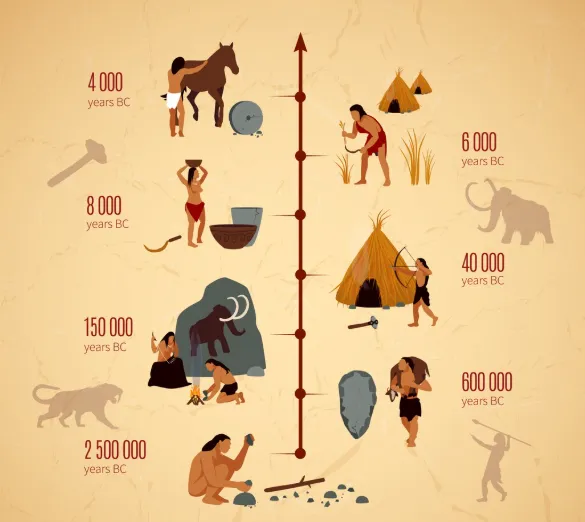
For centuries, people have been curious about where humans came from and how modern societies emerged. While history books can trace civilizations back thousands of years, the story of humanity stretches much further into the past. Scientists now know that modern humans are part of a much larger evolutionary story involving numerous ancestors, extinct relatives, and millions of years of biological change.
Understanding this story requires more than studying ancient artifacts. Researchers use fossils, DNA evidence, and archaeological discoveries to reconstruct a vast Human Family Tree that connects modern humans to their ancient ancestors. Each discovery adds another piece to the puzzle, helping scientists better understand how different species are related and how humanity developed over time.
By examining the Human Ancestor Timeline, researchers can organize these discoveries and build a clearer picture of the long journey that eventually led to modern humans.
Why Mapping Human Ancestry Is Challenging
Unlike a traditional family tree that records parents, grandparents, and relatives, tracing human ancestry over millions of years is far more complicated.
Many ancient species disappeared long before written records existed. In most cases, scientists must rely on limited evidence, such as fossilized bones, teeth, footprints, and genetic clues. Because fossil discoveries are often incomplete, researchers sometimes spend years debating exactly where a species belongs within the broader evolutionary story.
This is one reason the Human Family Tree continues to evolve. Discoveries regularly challenge previous assumptions and occasionally force scientists to rethink long-standing theories about human origins.
Rather than being a finished map, the tree remains a work in progress that becomes more detailed as new evidence emerges.
How Fossils Help Build the Human Family Tree
Fossils are among the most important tools available to paleoanthropologists, the scientists who study human origins.
A fossil can reveal valuable information about:
-
Body size and shape
-
Brain capacity
-
Walking ability
-
Diet and lifestyle
-
Environmental adaptations
By comparing fossils from different periods, researchers can identify similarities and differences between species. These comparisons help determine how certain groups may be connected.
For example, changes in skull structure, jaw shape, and skeletal design can provide clues about how species evolved and adapted over time.
The Human Family Tree relies heavily on these physical connections to establish relationships between ancient ancestors and modern humans.
The Role of Genetics in Understanding Human Origins
While fossils provide physical evidence, genetics has transformed the study of human evolution in recent decades.
Advances in DNA analysis allow scientists to compare genetic material from ancient remains with modern populations. These comparisons reveal surprising insights into ancestral relationships and migration patterns.
Genetic evidence has helped researchers:
-
Confirm connections between species
-
Study population movement across continents
-
Understand inherited traits
-
Identify previously unknown relationships
As genetic technology improves, the Human Ancestor Timeline becomes increasingly detailed and accurate.
DNA research has shown that human history is often more complex than scientists originally believed, revealing interactions between different human populations throughout history.
Discoveries That Changed Scientific Understanding
Some discoveries have dramatically reshaped how scientists view human evolution.
In the past, many researchers imagined human evolution as a simple progression from one species to another. Modern evidence suggests a much more complicated picture.
Scientists now understand that multiple human relatives existed at different times. Some species lived alongside one another, while others disappeared without leaving direct descendants.
These discoveries demonstrate that the Human Family Tree resembles a branching network rather than a straight line. Different branches emerged, adapted, and sometimes ended, while others contributed to later populations.
This complexity continues to make human evolution one of the most fascinating fields of scientific research.
What the Human Ancestor Timeline Reveals
One of the greatest benefits of the Human Ancestor Timeline is its ability to place discoveries into context.
Without a timeline, fossils and genetic findings would appear as isolated pieces of information. By organizing discoveries chronologically, scientists can better understand how different species appeared, adapted, and interacted over millions of years.
The timeline helps researchers answer important questions such as:
-
When did major evolutionary changes occur?
-
Which ancestors lived during the same periods?
-
How did migration influence development?
-
What environmental challenges shaped evolution?
These insights provide a clearer understanding of humanity’s long and complex history.
Why Human Ancestry Research Still Matters
The study of human origins is not simply about learning what happened in the distant past. Research into human ancestry also helps scientists understand biology, genetics, adaptation, and even modern health.
Every discovery contributes to a broader understanding of how humans evolved and why certain traits developed. It also highlights the remarkable ability of human populations to adapt to changing environments over time.
As new fossils are uncovered and genetic techniques continue advancing, scientists will likely uncover even more details about humanity’s origins.
Final Thoughts
The story of human evolution is far more complex than a simple line of descent. Through fossil discoveries, genetic research, and ongoing scientific investigation, researchers continue expanding the Human Family Tree and uncovering new connections between ancient species and modern humans.
The Human Ancestor Timeline serves as a valuable framework for organizing these discoveries, helping scientists understand how humanity developed across millions of years. As research continues, each new finding brings us closer to understanding one of science’s most important questions: how humans became who they are today.