
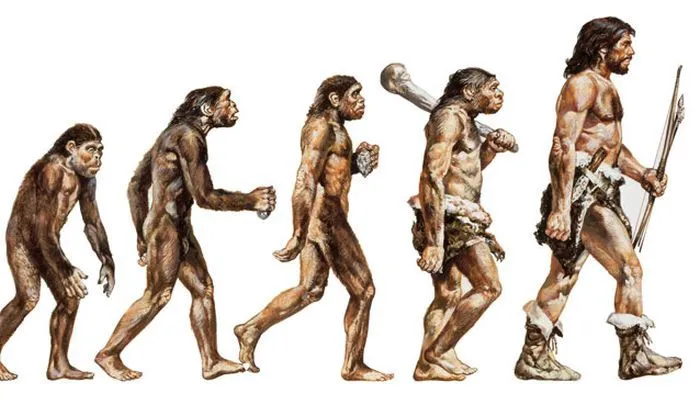
Human evolution is often introduced through a sequence of species arranged from oldest to newest. That format is useful, but it can also create the wrong impression. People searching for human evolution stages in order may expect a clean chain in which one species simply becomes the next. The fossil record tells a more complicated story. Evolution works through branching populations, extinctions, overlap, and uncertain relationships. A timeline is most useful when treated as a guide to important stages rather than a guaranteed family line.
A Timeline Is a Learning Tool
Chronological order helps readers see large changes across deep time. Early mammals appear long before primates, apes emerge much later, and hominins occupy only the most recent part of the story.
At the same time, a timeline cannot display every branch. Many species lived alongside close relatives, and some lineages ended without leaving descendants. Others may be closely related to later groups without being their direct ancestors. An ordered list should therefore be read as a set of evolutionary reference points.
Why Juramaia Appears So Early
One striking starting point is juramaia sinensis, a tiny mammal known from China. It is important because its original 2011 description interpreted the fossil as an early eutherian, placing it near the broader branch that eventually includes living placental mammals.
That does not make Juramaia a direct human ancestor. Humans did not descend from a shrew-like animal called Juramaia through a simple series of named species. The fossil matters because it helps scientists investigate the early history of the mammalian branch from which primates eventually emerged.
Its exact age and evolutionary placement have also been debated in later research. That uncertainty is a useful reminder that fossil timelines can change when dating or phylogenetic analysis is revised.
Different Stages Answer Different Questions
A long human-evolution timeline combines several scientific stories. Early mammal fossils address the origins of major mammalian groups. Later primates help researchers study traits associated with monkeys and apes. Miocene apes provide evidence about early hominoid diversity. Hominin fossils then become central to questions about bipedalism, teeth, diet, brain size, tools, dispersal, and eventually culture.
This is why the distance between stages can be enormous. Tens of millions of years may separate two early points, while later Homo species can be separated by much shorter intervals.
Branching Matters More Than Progress
Popular illustrations once showed evolution as a march from an ape-like creature toward an upright modern human. That image is misleading because it suggests that evolution has a predetermined goal. Natural selection works with variation in particular environments. Several related species can exist at the same time, and evolutionary success does not mean becoming more human-like.
The human family tree therefore looks more like a branching bush. Neanderthals and Homo sapiens, for example, overlapped in time, and genetic evidence shows that their populations interbred.
Fossil Dates Are Usually Approximations
Dates on evolutionary timelines are rarely exact. A fossil may be assigned an age range using its geological layer, associated volcanic material, or other dating methods. The oldest known fossil of a species also does not reveal the precise moment that species first evolved.
Discoveries can extend a species’ known range or change how scientists interpret its relationships. Even familiar labels can be revised when researchers compare new anatomy or genetic evidence. That does not make evolutionary science unreliable. It shows how science improves by testing earlier interpretations against new evidence.
Focus on Traits, Not Just Names
A strong way to study evolution is to follow traits across the timeline. Bipedal walking, reduced canine teeth, changes in hand function, larger brains, stone-tool use, long-distance dispersal, and symbolic behavior did not all appear at once.
Different fossils preserve different parts of that story. One species may be important for locomotion, another for diet, and another for technology. Looking at traits makes it easier to understand why a fossil matters even when its exact position in the family tree remains uncertain.
Conclusion
Human evolution becomes clearer when chronological stages are used as signposts rather than steps on a ladder. Early mammals, primates, apes, hominins, and later Homo species each illuminate different questions about the biological history that eventually produced our species.
The most accurate approach combines order with uncertainty. Dates are approximate, branches overlap, and not every featured species is a confirmed direct ancestor. A good timeline does more than show what came earlier or later; it helps readers understand how many fossils contribute to an evolving picture of human origins.